Reading Materials Books, Websites and Journals
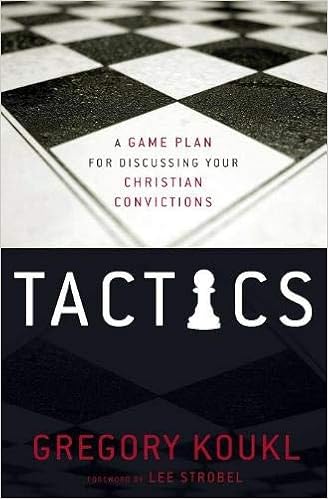
Tactics
Gregory Koukl
In a world indifferent or even opposed to Christian truth, followers of Christ must be better equipped to communicate the timeless of the Christian faith. But how do you have a conversation with someone who is intent on proving you wrong and won't accept the Bible as a source of authority?
In Tactics, Gregory Koukl demonstrates how to artfully regain control of conversations, keeping them moving forward in constructive ways through thoughtful diplomacy. You'll learn how to maneuver comfortably and graciously through the minefields of a challenging discussion, how to stop challengers in their tracks, and how to turn the tables on question or provocative statement. Most importantly, you'll learn how to get people thinking about Jesus.
Drawing on extensive experience defending Christianity in the public square, Koukl shows you how to:
- Initiate conversations effortlessly
- Present the truth clearly, cleverly, and persuasively
- Graciously and effectively expose faulty thinking
- Skillfully manage the details of dialogue
- Maintain an engaging, disarming style even under attack
Tactics provides the game plan for communicating the compelling truth about Christianity with confidence and grace.

How Should We Then Live?: The Rise and Decline of Western Thought and Culture
Francis A. Schaeffer
Worldview is fundamental to existence. So fundamental, in fact, that every single human being has one, whether they realize it or not. A worldview is a set of assumptions, presuppositions if you will, which are the lenses through which we see the world and interpret it and our place therein. In his book How Should We Then Live?, Francis Schaeffer traces the history of Western culture all the way from the Roman Empire to the present day, detailing the underlying worldview of the people in each of the great epochs of Christianity’s existence. The goal of such an endeavor is to prove that only the true Christian faith, that which is based upon what God has revealed to us in His Word, can make sense of the world consistently. All other worldviews inevitably fall short.
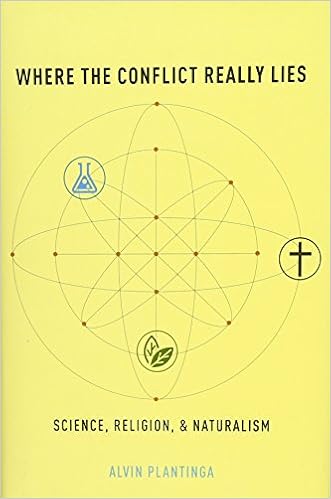
Where the Conflict Really Lies: Science, Religion, and Naturalism
Alvin Plantinga
This book is a long-awaited major statement by a pre-eminent analytic philosopher, Alvin Plantinga, on one of our biggest debates—the compatibility of science and religion. The last twenty years has seen a cottage industry of books on this divide, but with little consensus emerging. Plantinga, as a top philosopher but also a proponent of the rationality of religious belief, has a unique contribution to make. His theme in this short book is that the conflict between science and theistic religion is actually superficial, and that at a deeper level they are in concord.
Plantinga examines where this conflict is supposed to exist—evolution, evolutionary psychology, analysis of scripture, scientific study of religion—as well as claims by Dan Dennett, Richard Dawkins, and Philip Kitcher that evolution and theistic belief cannot co-exist. Plantinga makes a case that their arguments are not only inconclusive but that the supposed conflicts themselves are superficial, due to the methodological naturalism used by science. On the other hand, science can actually offer support to theistic doctrines, and Plantinga uses the notion of biological and cosmological "fine-tuning" in support of this idea. Plantinga argues that we might think about arguments in science and religion in a new way—as different forms of discourse that try to persuade people to look at questions from a perspective such that they can see that something is true. In this way, there is a deep and massive consonance between theism and the scientific enterprise.
Can Science Explain Everything?
John Lennox
Can science explain everything?
Many people think so. Science, and the technologies it has spawned, has delivered so much to the world: clean water; more food; better healthcare; longer life. And we live in a time of rapid scientific progress that holds enormous promise for many of the problems we face as humankind. So much so, in fact, that many see no need or use for religion and belief systems that offer us answers to the mysteries of our universe. Science has explained it, they assume. Science and religion just do not mix.
Oxford Maths Professor and Christian believer Prof. John Lennox offers a fresh way of thinking about science and Christianity that dispels the common misconceptions about both. He reveals that not only are they not opposed, but they can and must mix to give us a fuller understanding of the universe and the meaning of our existence.
Mind & Cosmos: Why the Materialist Neo-Darwinian Conception of Nature is Almost Certainly False
Thomas Nagel
The modern materialist approach to life has conspicuously failed to explain such central mind-related features of our world as consciousness, intentionality, meaning, and value. This failure to account for something so integral to nature as mind, argues philosopher Thomas Nagel, is a major problem, threatening to unravel the entire naturalistic world picture, extending to biology, evolutionary theory, and cosmology.
Since minds are features of biological systems that have developed through evolution, the standard materialist version of evolutionary biology is fundamentally incomplete. And the cosmological history that led to the origin of life and the coming into existence of the conditions for evolution cannot be a merely materialist history, either. An adequate conception of nature would have to explain the appearance in the universe of materially irreducible conscious minds, as such.
Nagel's skepticism is not based on religious belief or on a belief in any definite alternative. In Mind and Cosmos, he does suggest that if the materialist account is wrong, then principles of a different kind may also be at work in the history of nature, principles of the growth of order that are in their logical form teleological rather than mechanistic.
In spite of the great achievements of the physical sciences, reductive materialism is a world view ripe for displacement. Nagel shows that to recognize its limits is the first step in looking for alternatives, or at least in being open to their possibility.
The Waning of Materialism
Robert C. Koons (Editor), George Bealer (Editor)
Warning: This is a heavy, difficult read for the uninitiated.
Twenty-three philosophers examine the doctrine of materialism find it wanting. The case against materialism comprises arguments from conscious experience, from the unity and identity of the person, from intentionality, mental causation, and knowledge. The contributors include leaders in the fields of philosophy of mind, metaphysics, ontology, and epistemology, who respond ably to the most recent versions and defenses of materialism. The modal arguments of Kripke and Chalmers, Jackson's knowledge argument, Kim's exclusion problem, and Burge's anti-individualism all play a part in the building of a powerful cumulative case against the materialist research program. Several papers address the implications of contemporary brain and cognitive research (the psychophysics of color perception, blindsight, and the effects of commissurotomies), adding a posteriori arguments to the classical a priori critique of reductionism. All of the current versions of materialism--reductive and non-reductive, functionalist, eliminativist, and new wave materialism--come under sustained and trenchant attack. In addition, a wide variety of alternatives to the materialist conception of the person receive new and illuminating attention, including anti-materialist versions of naturalism, property dualism, Aristotelian and Thomistic hylomorphism, and non-Cartesian accounts of substance dualism.
Intellectuals: From Marx and Tolstoy to Sartre and Chomsky
Paul Johnson
A fascinating portrait of the minds that have shaped the modern world. In an intriguing series of case studies, Rousseau, Shelley, Marx, Ibsen, Tolstoy, Hemingway, Bertrand Russell, Brecht, Sartre, Edmund Wilson, Victor Gollancz, Lillian Hellman, Cyril Connolly, Norman Mailer, James Baldwin, Kenneth Tynan, and Noam Chomsky, among others, are revealed as intellectuals both brilliant and contradictory, magnetic and dangerous.
The book examines whether intellectuals are morally fit to give advice to humanity.
Do the private practices of intellectuals match the standard of their public principles?
How great is their respect for truth? What is their attitude to money? How do they treat their spouses and children - legitimate and illegitimate? How loyal are they to their friends?
With wit and brilliance, Paul Johnson exposes these intellectuals, and questions whether ideas should ever be valued more than individuals.
Who Is This Man?: The Unpredictable Impact of the Inescapable Jesus
John Ortberg
Jesus' impact on our world is highly unlikely, widely inescapable, largely unknown, and decidedly double-edged. It is unlikely in light of the severe limitations of his earthly life; it is inescapable because of the range of impact; it is unknown because history doesn't connect dots; and it is doubled-edged because his followers have wreaked so much havoc, often in his name.
He is history's most familiar figure, yet he is the man no one knows. His impact on the world is immense and non-accidental. From the Dark Ages to Post-Modernity he is the Man who won't go away.
And yet . . .you can miss him in historical lists for many reasons, maybe the most obvious being the way he lived his life. He did not loudly and demonstrably defend his movement in the spirit of a rising political or military leader. He did not lay out a case that history would judge his brand of belief superior in all future books.
His life and teaching simply drew people to follow him. He made history by starting in a humble place, in a spirit of love and acceptance, and allowing each person space to respond.
His vision of life continues to haunt and challenge humanity. His influence has swept over history bringing inspiration to what has happened in art, science, government, medicine, and education; he has taught humans about dignity, compassion, forgiveness, and hope.
The Devil's Delusion: Atheism and its Scientific Pretensions
David Berlinski
Bestselling author David Berlinski's wise and witty assault on the pretensions of the scientific atheists